

How We Built a High-Converting Cold Email System for a Video Studio with Technical DNS Setup, Bulletproof Deliverability, and Precision Copy…
A look inside our live campaign: Why we dialed in domain records, turned off open tracking, and focused on pure deliverability to turn resistant leads into booked meetings…
There is a version of cold email that looks very simple from the outside.
Find a list… Write three emails… Load everything into Instantly… PRESS LAUNCH.
This was not that project.
Aaron runs a St. Louis video studio. He wanted monthly content retainers from local med spas… businesses that already understood the value of showing up online, but did not want to plan, shoot, and edit content every week.
The offer was good. One quarterly shoot could become a steady stream of reels, educational videos, staff stories, and social content.
But before I could put that offer in front of anyone, I had to answer a less exciting question:
Could his emails reach the inbox at all?
That question changed the whole job.
Instead of becoming a copywriting project with a little setup at the end, it became a complete cold-email build: domains, authentication, warm-up, research, list cleanup, personalized sequences, approval, testing, launch, and reply handoff.
Here is how it came together…
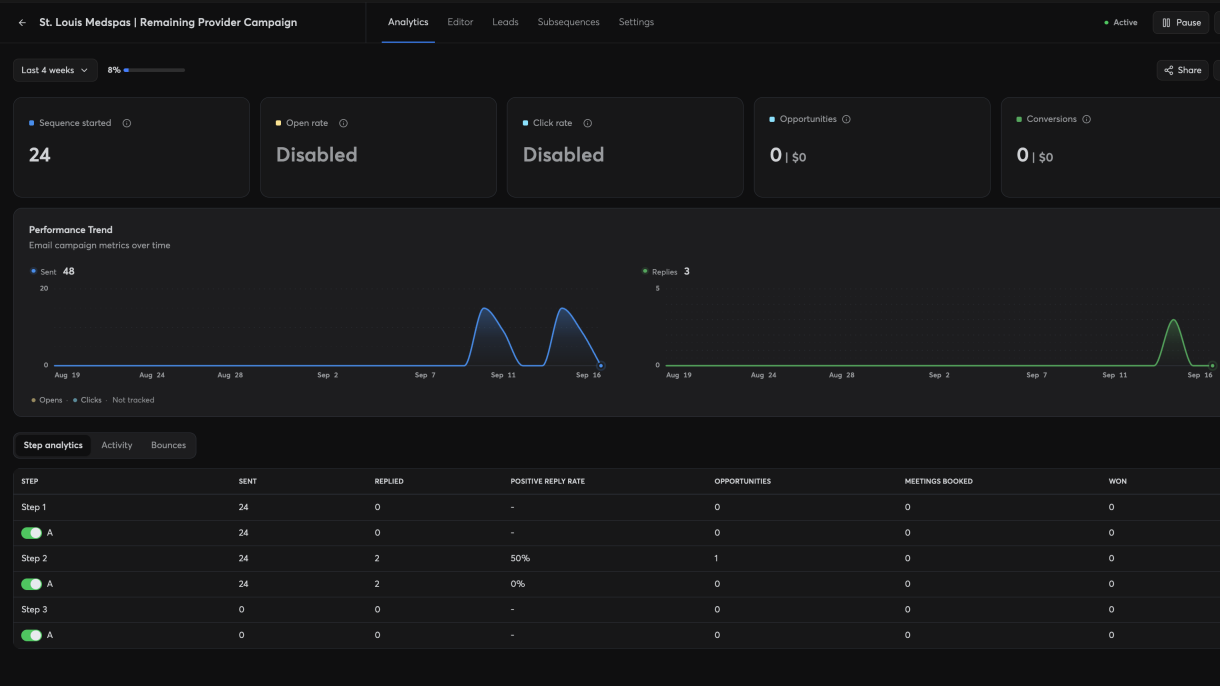
The numbers at the time of writing this case study…
- 7-contact Microsoft pilot
- 24-contact second campaign
- 69 total sends
- 0 recorded bounces
- 95% seed-test inbox placement
- 2 people replied
- 1 booked call
These are early campaign numbers, not a revenue victory lap. Only one booked so far. So… so far so good. But what I wanna also do is show you the grunt work and the raw data behind all this.
The first surprise was hiding in the sending setup…
I checked the sending foundation before I wrote the campaign.
DKIM was passing. SPF and DMARC still needed attention.
That matters because personalization cannot rescue a sender that receiving servers do not trust. A beautiful email in spam is still a failed email.
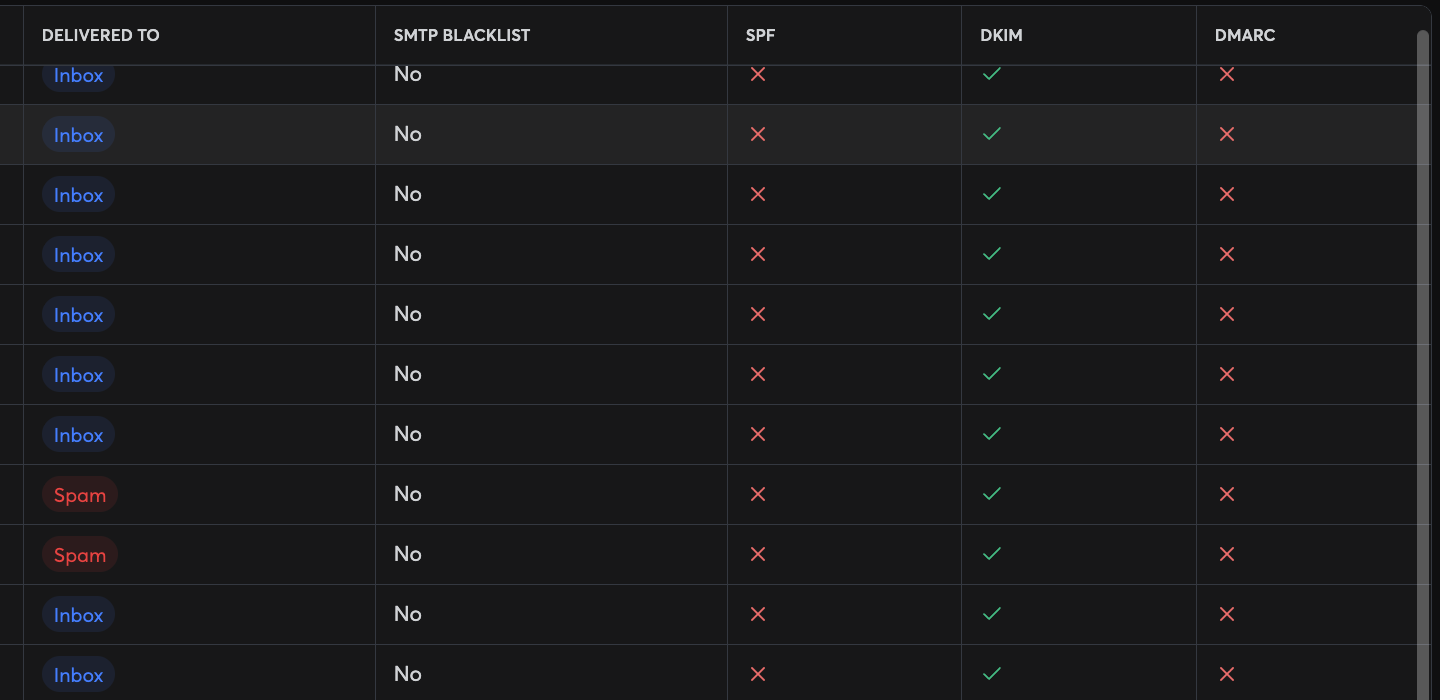
The first audit. DKIM passed, but the other authentication pieces were not ready yet.
So I paused the “let’s write some emails” instinct and worked through the domains first.
We added the missing records, waited for propagation, and checked the live DNS rather than assuming that a saved record meant a working record.
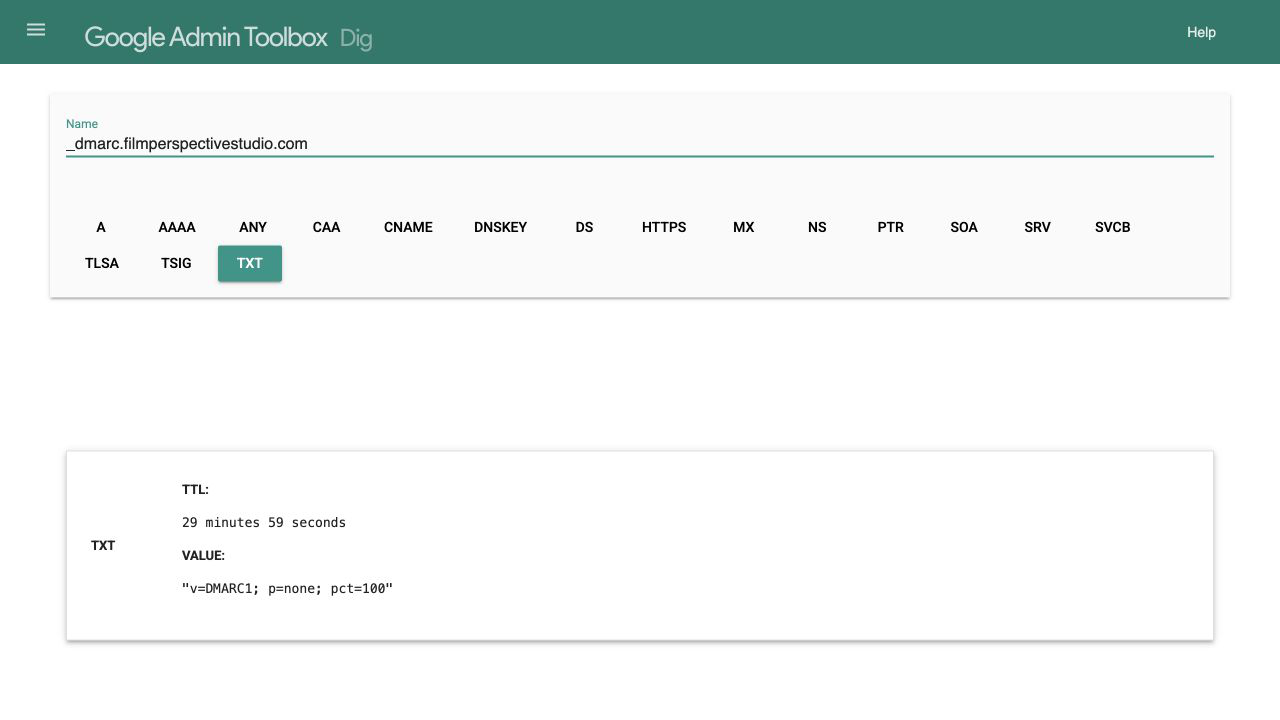
A live DMARC lookup for one of the sending domains.
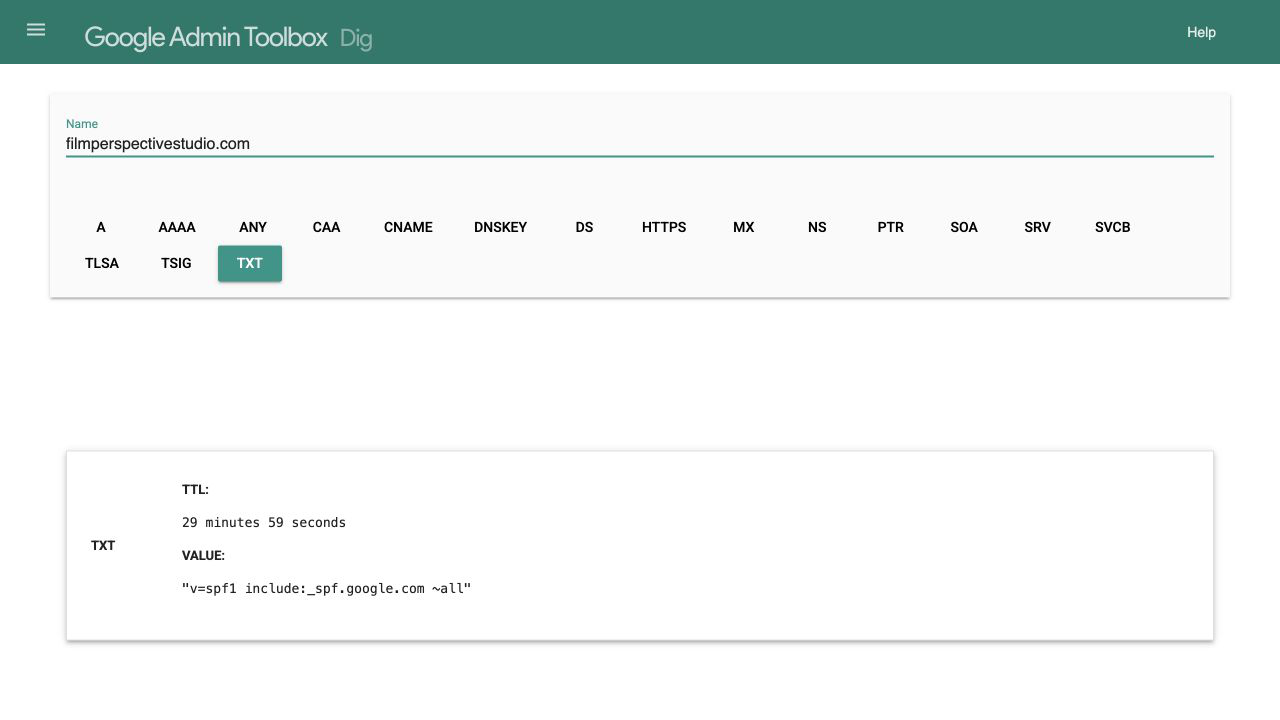
The matching SPF lookup.
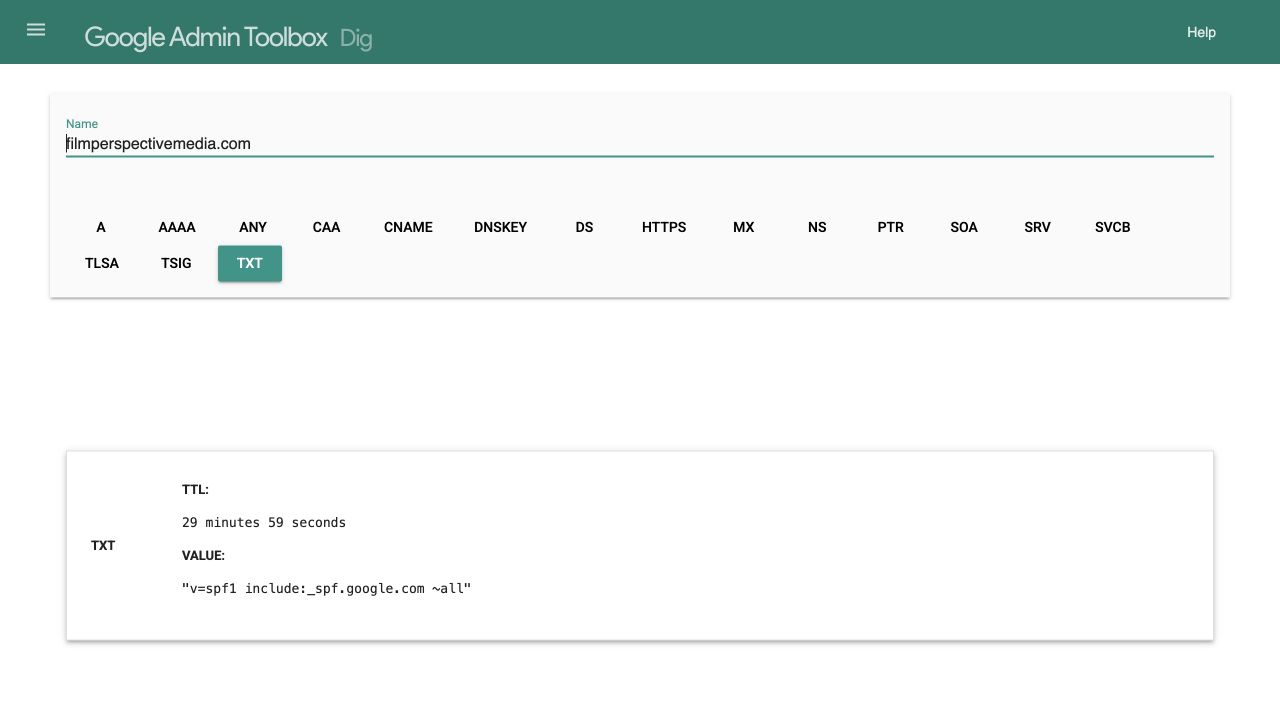
The second domain resolving its SPF record.
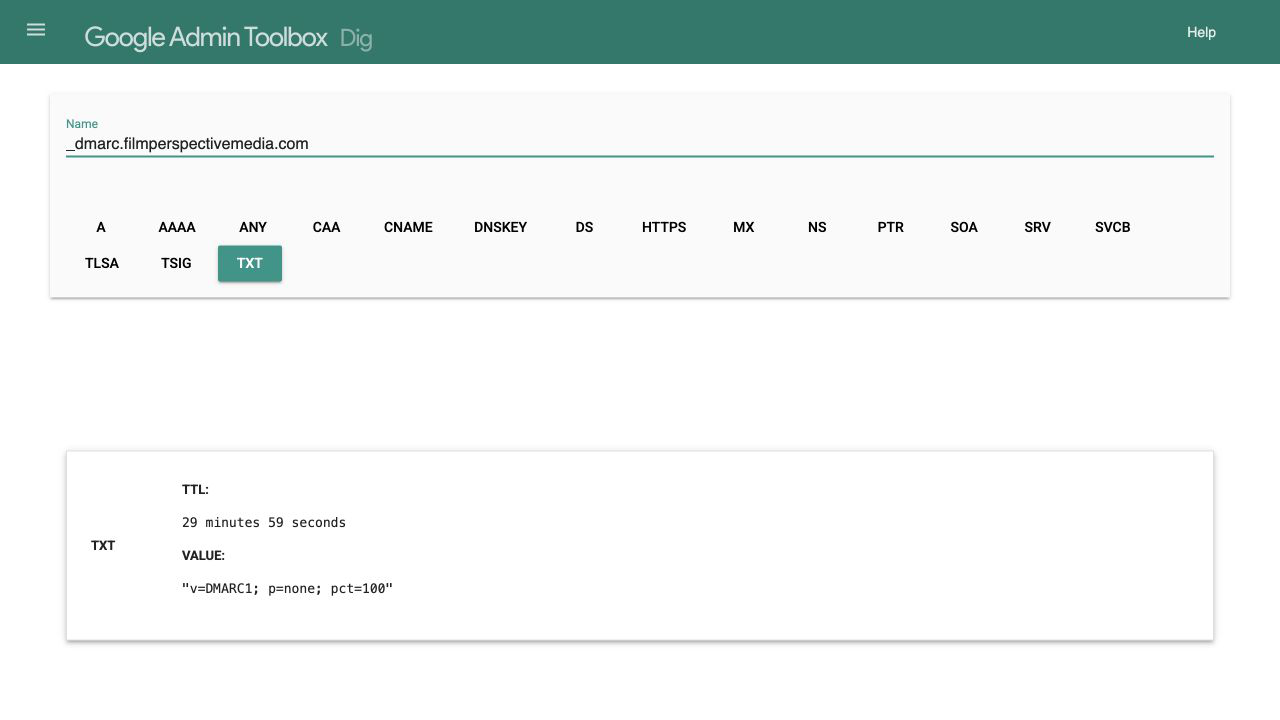
The second domain resolving DMARC as well.
I kept warm-up running while I worked on the list and copy. That gave the inboxes more time to develop a sending history instead of sitting idle until launch day.
We also agreed on a launch bar. I was looking for at least 90% Google inbox placement, no individual sender below 80%, a spam score below 5, authentication passing, no blacklist problem, and no more than 2% bounces in the pilot.
Those numbers gave us something better than “it feels ready.”
They gave us a reason to launch… or a reason to wait.
The spreadsheet became the real campaign
Once the domains were moving in the right direction, I went deep on St. Louis med spas.
The list was never supposed to be huge. Aaron wanted owner-operated businesses close enough for a local production relationship. That meant a random directory export would create more problems than it solved.
For every business, I checked:
- Is it in the St. Louis market?
- Does the business look owner-led rather than chain-managed?
- Can I identify someone who can actually make a buying decision?
- Is the email address verifiable?
- Is there a real idea here, or am I forcing personalization onto a bad fit?
That last question removed more names than people expect.
An HR contact was not good enough. An admin address at a multi-state chain was not good enough. A location manager was not automatically good enough. One company was already in an active conversation with Aaron, so it came out before the pilot.
At one point we had 36 usable contacts. Then we kept tightening.
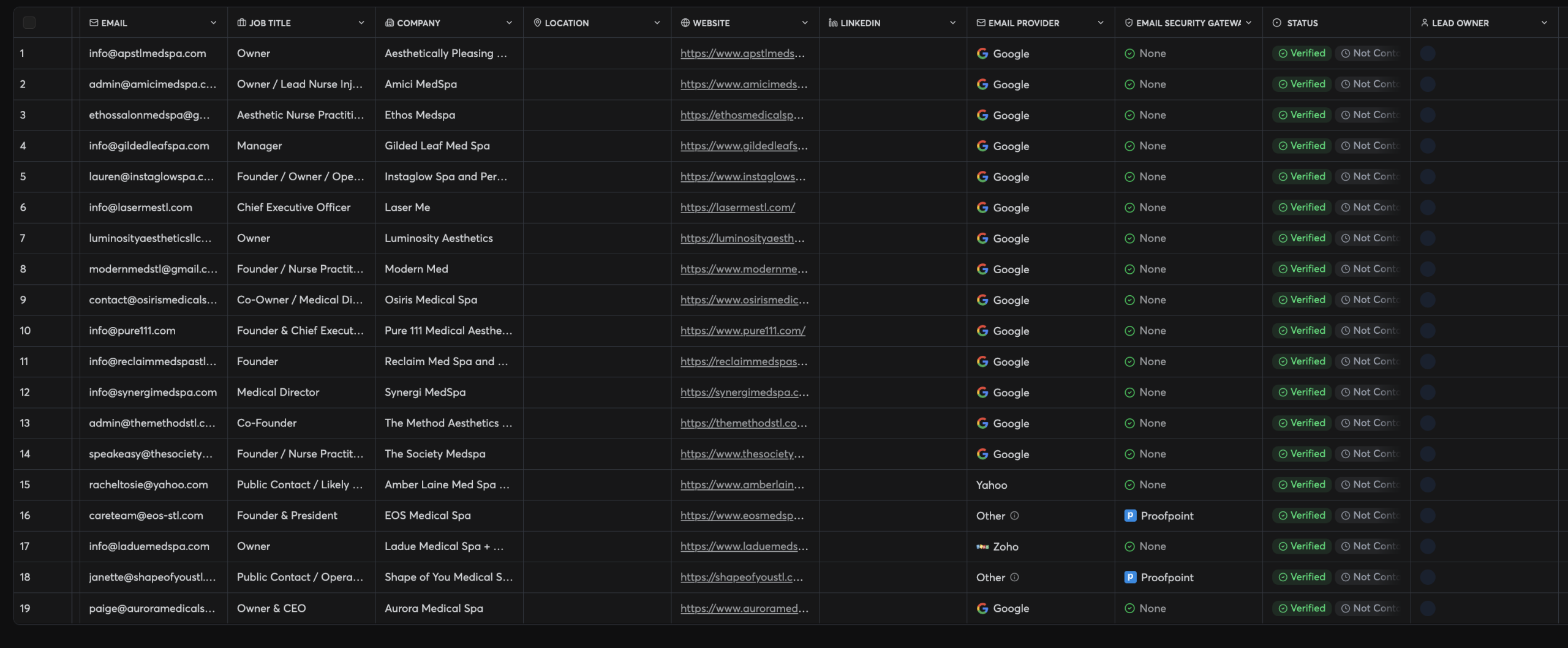
The Instantly lead view after verification. “More contacts” was never the goal. The right contact was.
One lead, Aurora, was allowed back in only after I found the owner and verified her mailbox. Look Lab was dropped because a general inbox at a multi-state chain did not match the owner-operated profile. Celsius was dropped when the available contact turned out to be a location manager.
That is what list cleaning looked like on this project. It was not deleting duplicates and calling it a day. It was deciding who had earned an email.
I wrote the emails around something each business already cared about
The lazy version of personalization would have been:
“I saw your website and loved what you’re doing…”
Then the same pitch 30 times.
I did something slower.
I looked for a statement, post, treatment philosophy, staff story, product line, or patient belief that could carry an ongoing video series.
For one spa, the idea came from a post about the women who had built their careers there. The sequence proposed a recurring “Why I Chose [Spa]” series, with each provider sharing what brought her there, what she had learned, and a client moment she still remembered.
For another, the business had its own skincare line. The sequence proposed an “Ethos at Home” series that would show where each formula fits, when to use it, and how it supports treatments between appointments.
For a practice built around careful patient education, the series became “Before You Decide.” Each episode could take one decision patients struggle with and show how the practitioner thinks it through.
Those ideas did more work than a compliment ever could.
They let the prospect picture the content before Aaron had to explain the whole service.
Here is what one live email looked like in the inbox:
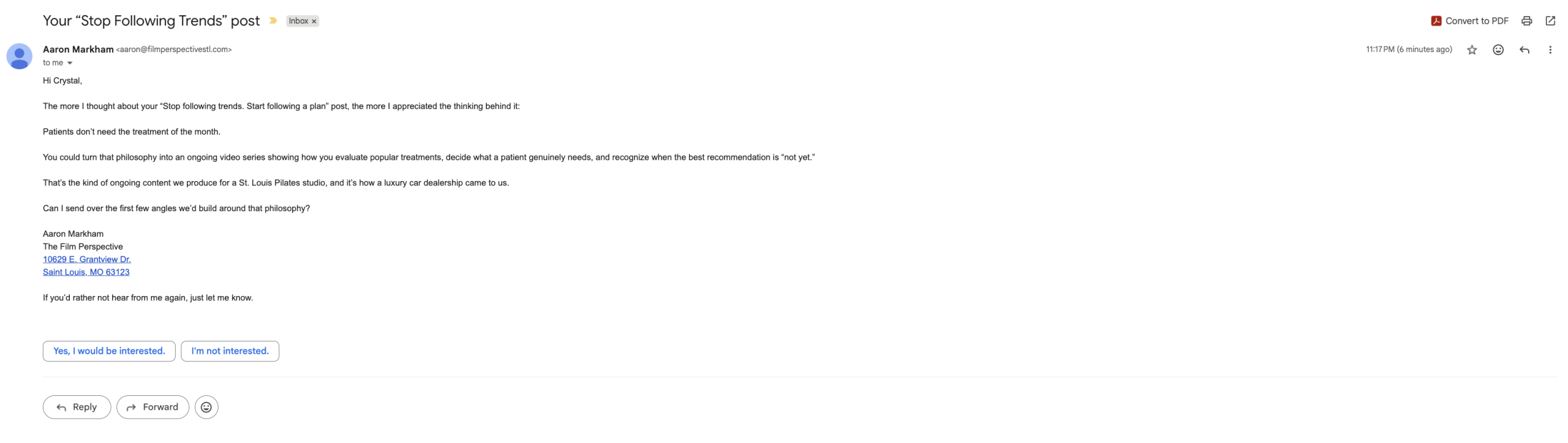
A real sent email. The first touch connects a public idea to a repeatable content series.
The three-email structure was simple:
- Email one introduced the series. It connected a real detail from the business to an idea they could use every month.
- Email two pictured the first episode. It showed what the idea might look like instead of sending a “just checking in” follow-up.
- Email three made the next step easy. The later campaign used Aaron’s booking link with a short lead-in instead of dropping a bare URL into the email.
Every complete email stayed under 120 words. Subject lines varied. Repeated “I love…” openings came out. Follow-ups stayed inside the original thread.
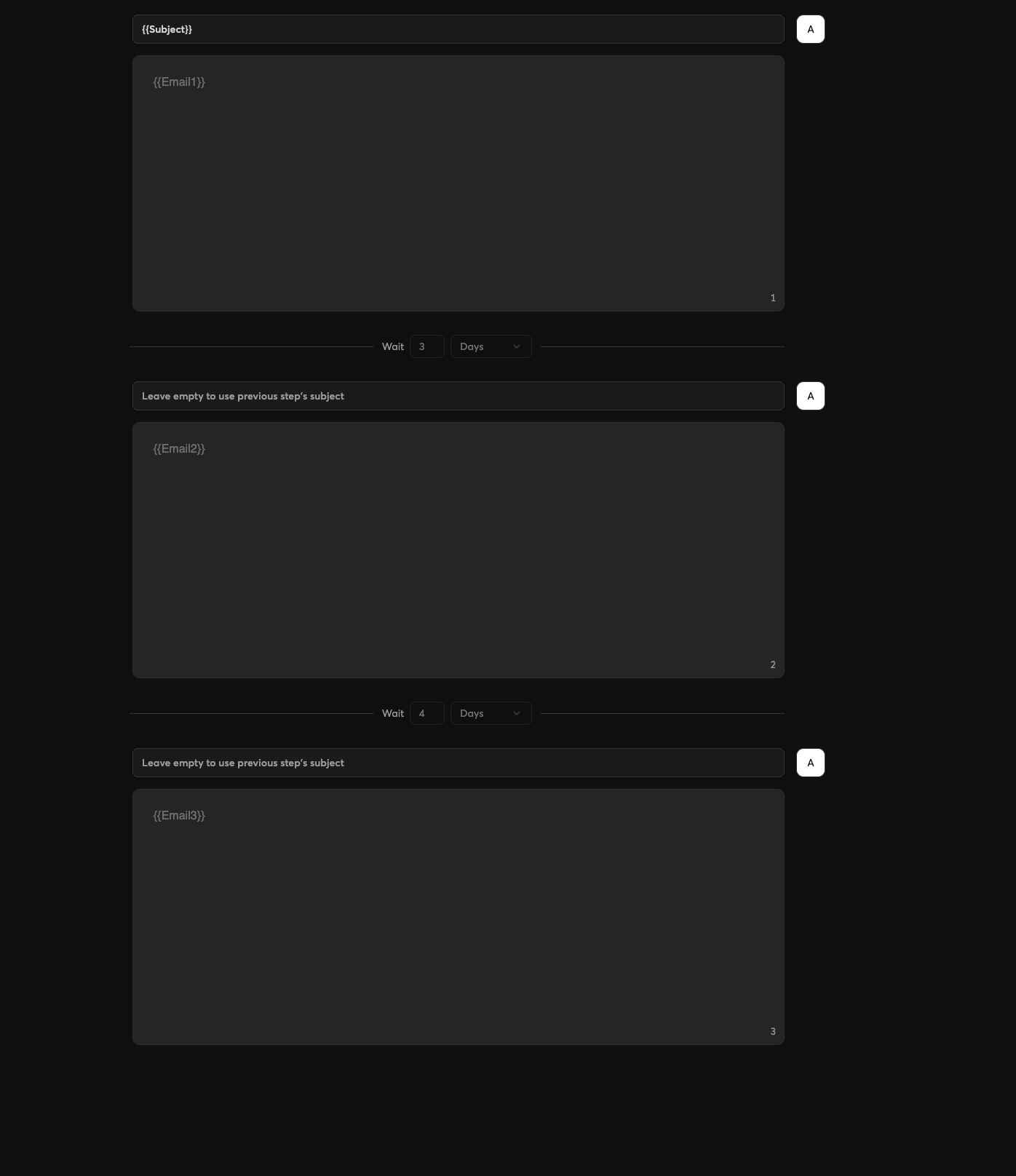
Three touches, with the follow-ups keeping the original subject line.
To make 24 different sequences manageable, I loaded the approved subject and three bodies as contact variables rather than building a fake “personalized” master template.
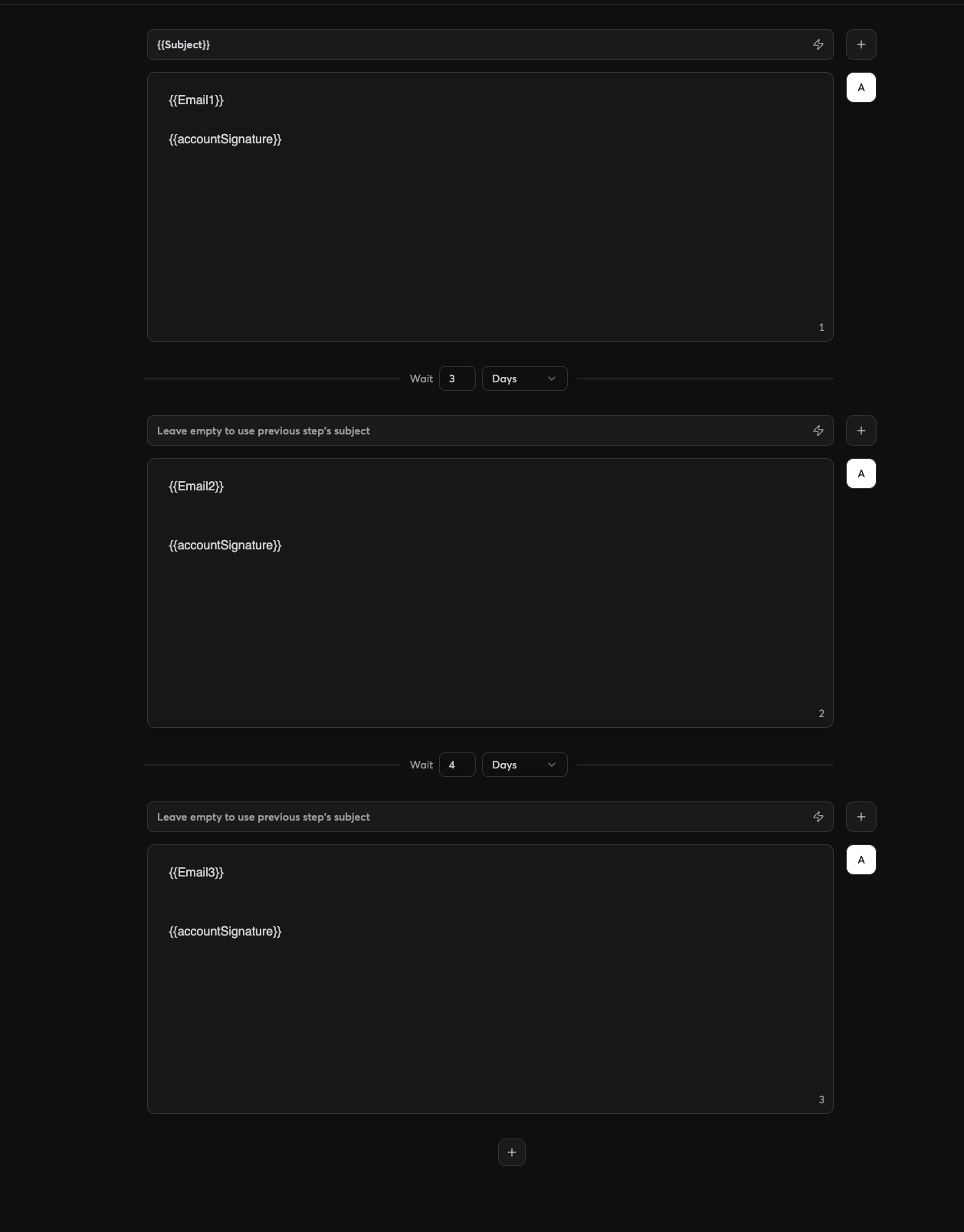
Each contact carried the copy written for that business.
The best way to show the strategy is to show the emails
So here are three of the strongest sequences from the campaign, in full.
I picked these three because they came from completely different places. One started with a point of view. One started with the owner’s relationship with her team. One started with a product line.
The structure stayed consistent, but the idea did not.
Sample 1: A point of view patients can feel before they book
- Business: Aesthetically Pleasing Medspa
- Contact: Crystal
- What I noticed: A post that said, “Stop following trends. Start following a plan.”
That line gave me the real angle. Crystal was not simply selling treatments. She was selling the judgment to know when a treatment made sense—and when it did not.
Touch 1 — Subject: Your “Stop Following Trends” post
Hi Crystal,
The more I thought about your “Stop following trends. Start following a plan” post, the more I appreciated the thinking behind it:
Patients don’t need the treatment of the month.
You could turn that philosophy into an ongoing video series showing how you evaluate popular treatments, decide what a patient genuinely needs, and recognize when the best recommendation is “not yet.”
That’s the kind of ongoing content we produce for a St. Louis Pilates studio, and it’s how a luxury car dealership came to us.
Can I send over the first few angles we’d build around that philosophy?
The first email did not lead with video production. It led with the belief underneath the business, then turned that belief into a series Crystal could immediately picture.
Touch 2 — Same thread
Hi Crystal,
In my last email, I mentioned a series built around your treatment plan philosophy. One I’d start with is “When The Answer Is No.”
Each short video could unpack a decision patients rarely see: when filler isn’t the right answer, why treatment order matters, when regenerative care makes more sense, or what you evaluate before recommending anything.
That would let patients experience your judgment before they ever sit down for a consultation, and make “natural results” mean something specific to Aesthetically Pleasing.
Should I map out the other directions I see as well?
No “just following up.” The second email spent the follow-up by making the first episode concrete.
Touch 3 — Same thread
Hi Crystal,
“When The Answer Is No” is only one piece of the opportunity I see for Aesthetically Pleasing.
You already have several stories worth developing: regenerative aesthetics, the clinical thinking behind PRP and PRF, natural lip work, under eye correction, treatment safety, and what 19 years in medicine changes about the way you plan results.
One focused quarterly shoot could turn those ideas into months of useful videos. Each one could help patients understand not just what you offer, but how you think.
Worth a 15-minute call? I’ll build your Month One Plan from our conversation and send it within 48 hours, yours either way. Choose a time:
By the third touch, I could widen the idea. The email moved from one philosophy, to one episode, to a quarter of useful content—then offered a specific next step.
Sample 2: Turning a team story into a reason to choose the business
- Business: Instaglow Spa and Permanent Makeup
- Contact: Lauren
- What I noticed: Lauren had written about the women who trusted Instaglow as a place to build their careers—and how they helped her become the leader she wanted to be.
That was more interesting than another treatment list. It was a human story patients could connect with before choosing who to book.
Touch 1 — Subject: The women who built Instaglow with you
Hi Lauren,
Your post about the women who trusted Instaglow as a place to build their careers was beautiful.
The part that really got me was you saying they helped you become the leader you always wanted to be.
That story could become a recurring ‘Why I Chose Instaglow’ video series. Each woman could share what brought her there, how she has grown and the client moments that make her proud of what she does.
That’s the kind of ongoing content we produce for a St. Louis Pilates studio, and it’s how a luxury car dealership came to us.
Want me to show you how the first month could introduce the women taking Instaglow into its fifth year?
The opening used Lauren’s own meaning, not a generic compliment. Then it gave the story a name: “Why I Chose Instaglow.” Naming the idea made it feel real.
Touch 2 — Same thread
Hi Lauren,
In my last email, I mentioned a ‘Why I Chose Instaglow’ series built around the women growing their careers with you.
The first episode could follow one team member from what brought her to Instaglow to the moment she realized she had found the right place to grow. She could share the confidence she has gained, the craft she has developed and a client experience she still remembers.
A potential client watching that would already know the woman behind the appointment and have a genuine reason to choose her.
Whose story do you think your clients would connect with first?
The question at the end was easy to answer because it asked Lauren to think about her people—not decide whether to buy a service from a stranger.
Touch 3 — Same thread
Hi Lauren,
Once clients know the women behind Instaglow, the treatment content becomes much more personal.
Grace’s story can lead naturally into how she creates a natural looking spray tan. Lexi can take clients behind what makes lashes last. Madi can show what actually happens during a head spa appointment.
That gives you a series that can keep growing without losing the human part that makes it worth watching. One shoot day could capture the team stories, treatment education and enough short videos to keep those services visible for weeks.
Worth a 15-minute call? I’ll build your Month One Plan from our conversation and send it within 48 hours, yours either way. Choose a time:
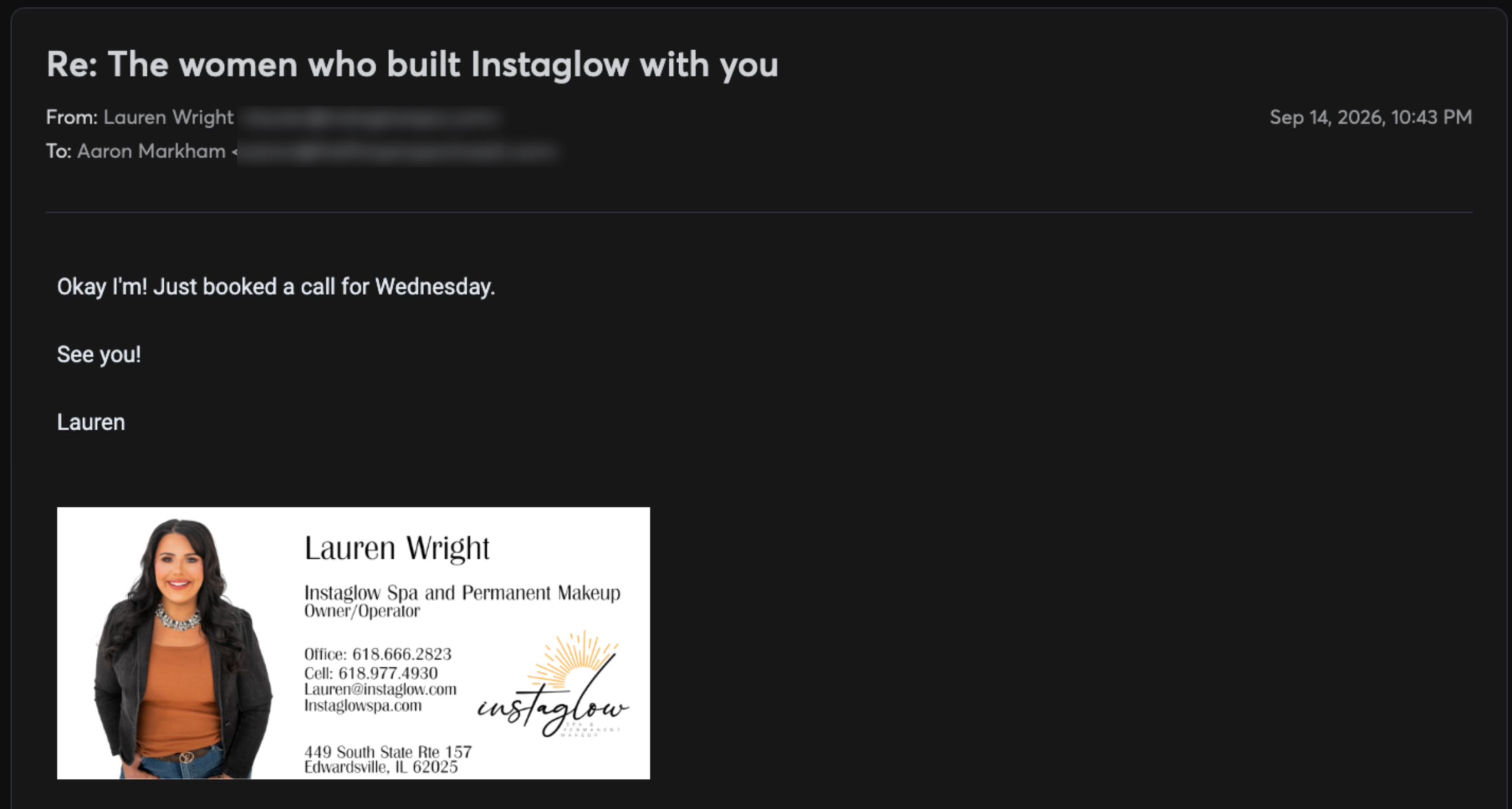
This sequence produced the first booked call!
Sample 3: Connecting the treatment room to what happens at home
- Business: Ethos Medspa
- Contact: Madeline
- What I noticed: Ethos had built its own skincare range instead of leaving patients to guess what to use between appointments.
That gave me a useful bridge: treatment, recovery, home care, and consistency.
Touch 1 — Subject: What you’re doing with Ethos Skincare
Hi Madeline,
Ethos Skincare is such a smart extension of what you are already doing in the treatment room.
Instead of sending clients home to figure out what comes next, you have built a complete range that helps them keep supporting their skin between appointments.
You could turn that into a monthly video series showing where each formula fits, when to use it and how it supports the treatments clients already trust Ethos for.
That’s the kind of ongoing content we produce for a St. Louis Pilates studio, and it’s how a luxury car dealership came to us.
Can I send over the three video angles I see inside Clear Skin Complex, Essential Daily SPF and Recovery Cream?
The important part was not “I saw you sell skincare.” It was understanding why the skincare existed inside the patient journey.
Touch 2 — Same thread
Hi Madeline,
In my last email, I mentioned three possible video angles inside Ethos Skincare.
One I would start with is “Ethos At Home: Clear Skin Complex.” The video could begin with the frustration of trying product after product while breakouts keep returning, then show how Clear Skin Complex helps unclog pores, balance oil and prevent new breakouts.
That would do more than explain the ingredients. It would help someone recognize her problem, understand where the product fits and picture using it in her daily routine. The same approach could work for Essential Daily SPF and Recovery Cream.
Should I map out those other two videos as well?
Again, the follow-up added something. It turned a broad series into a specific first video built around the customer’s problem, not a catalogue of ingredients.
Touch 3 — Same thread
Hi Madeline,
Those three product videos would give Ethos a strong place to start. But you already have enough connected stories to keep the idea going beyond the skincare range.
A consultation leads to a treatment. The treatment leads to recovery and home care. The VIP program gives clients a reason to stay consistent.
One focused quarterly shoot could capture enough of those stories to keep Ethos visible for months, with every video leading naturally to a treatment, a product or another visit.
Worth a 15-minute call? I’ll build your Month One Plan from our conversation and send it within 48 hours, yours either way. Choose a time:
The sequence began with one product line and ended with a simple content system tied to the way Ethos already serves patients.
The point across all three sequences is not that every line is clever.
It is that each email gives the reader a new reason to keep reading. The first touch names an idea. The second proves I have thought beyond the opener. The third shows the larger opportunity and makes the next step clear.
Then I built the guardrails around the copy…
The campaign used one sender at a time, a 15-email daily cap, office-hour sending, tracking off, stop-on-reply, and threaded follow-ups.
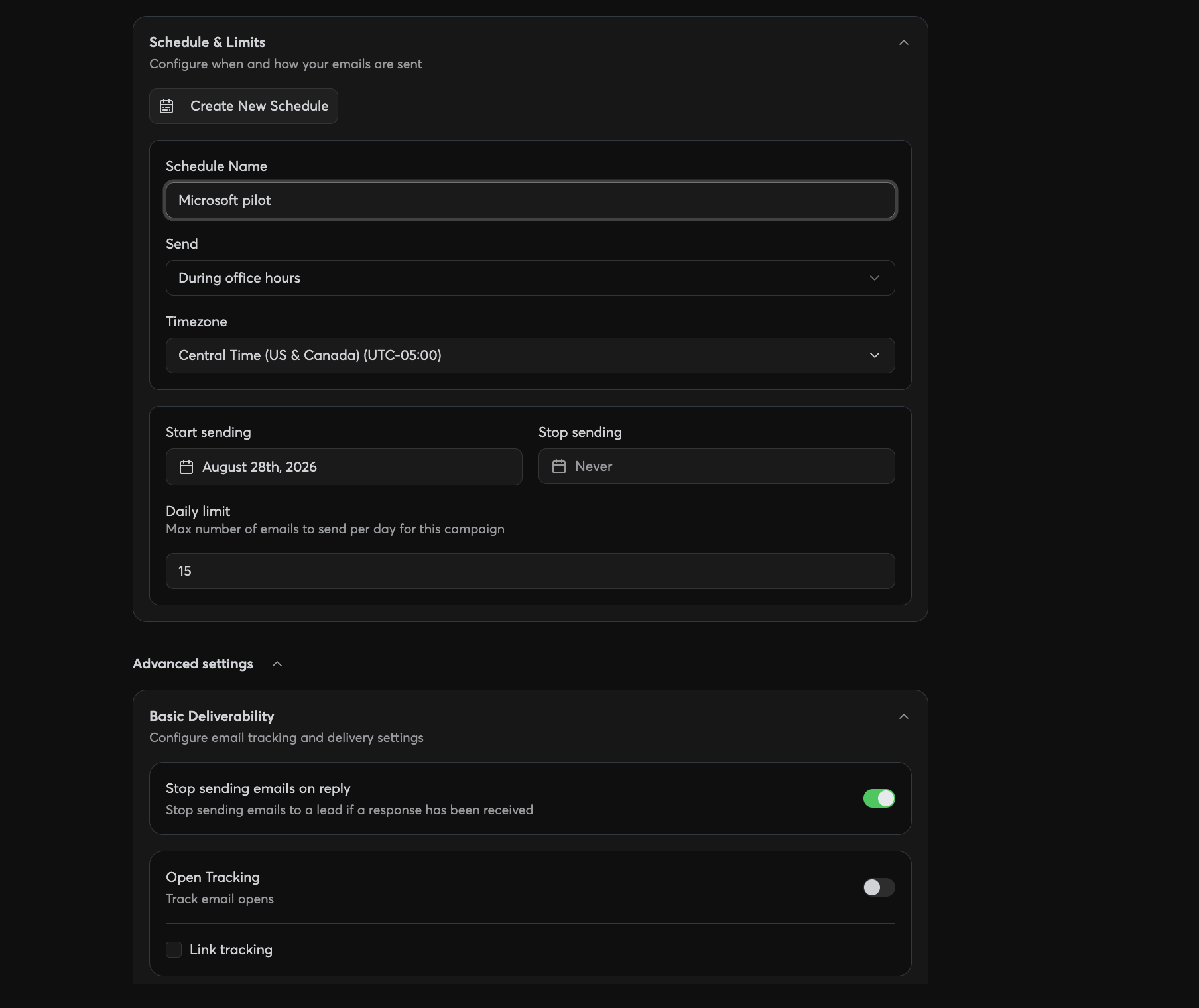
The sending schedule and the daily cap.
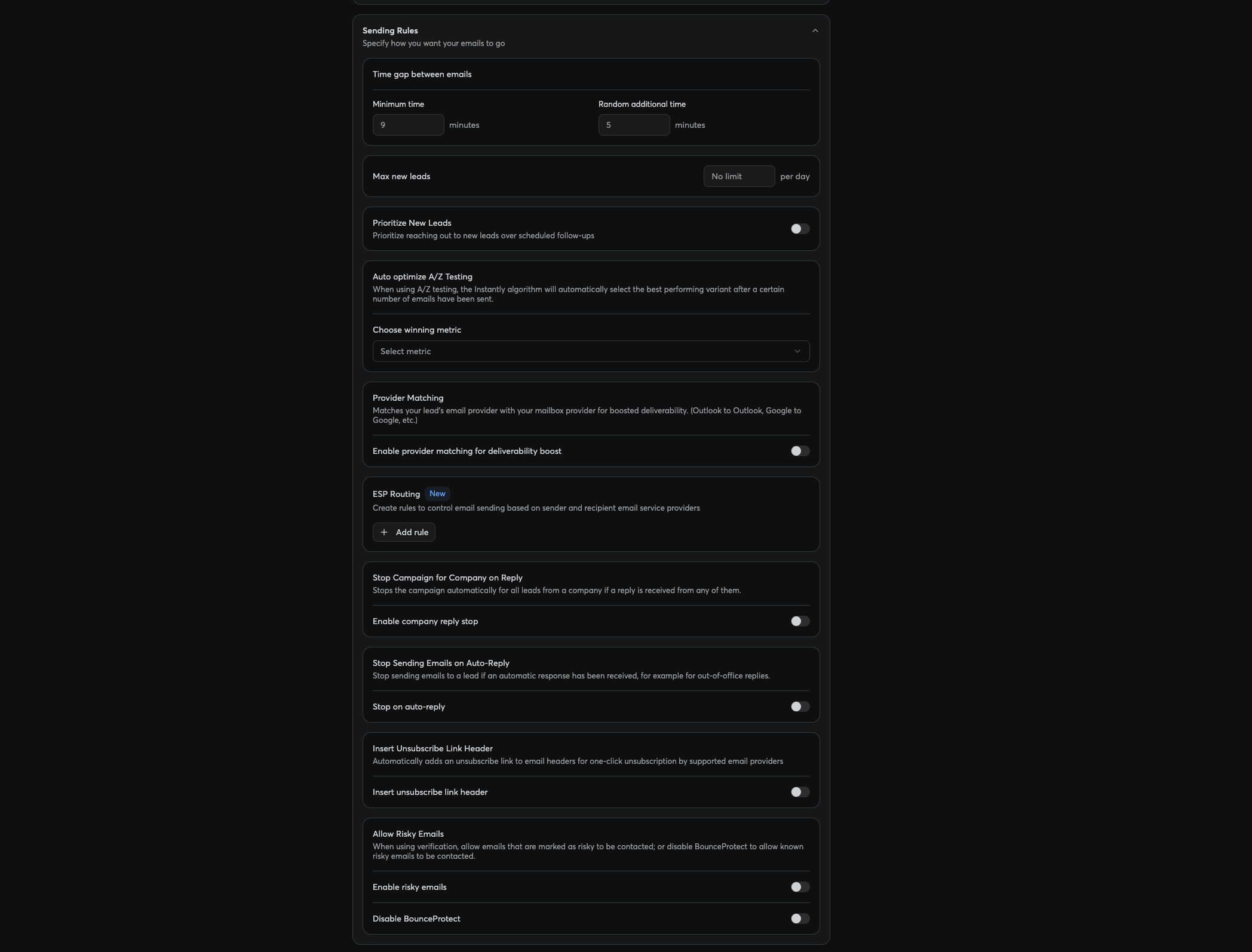
Stop-on-reply enabled. Open and link tracking disabled.
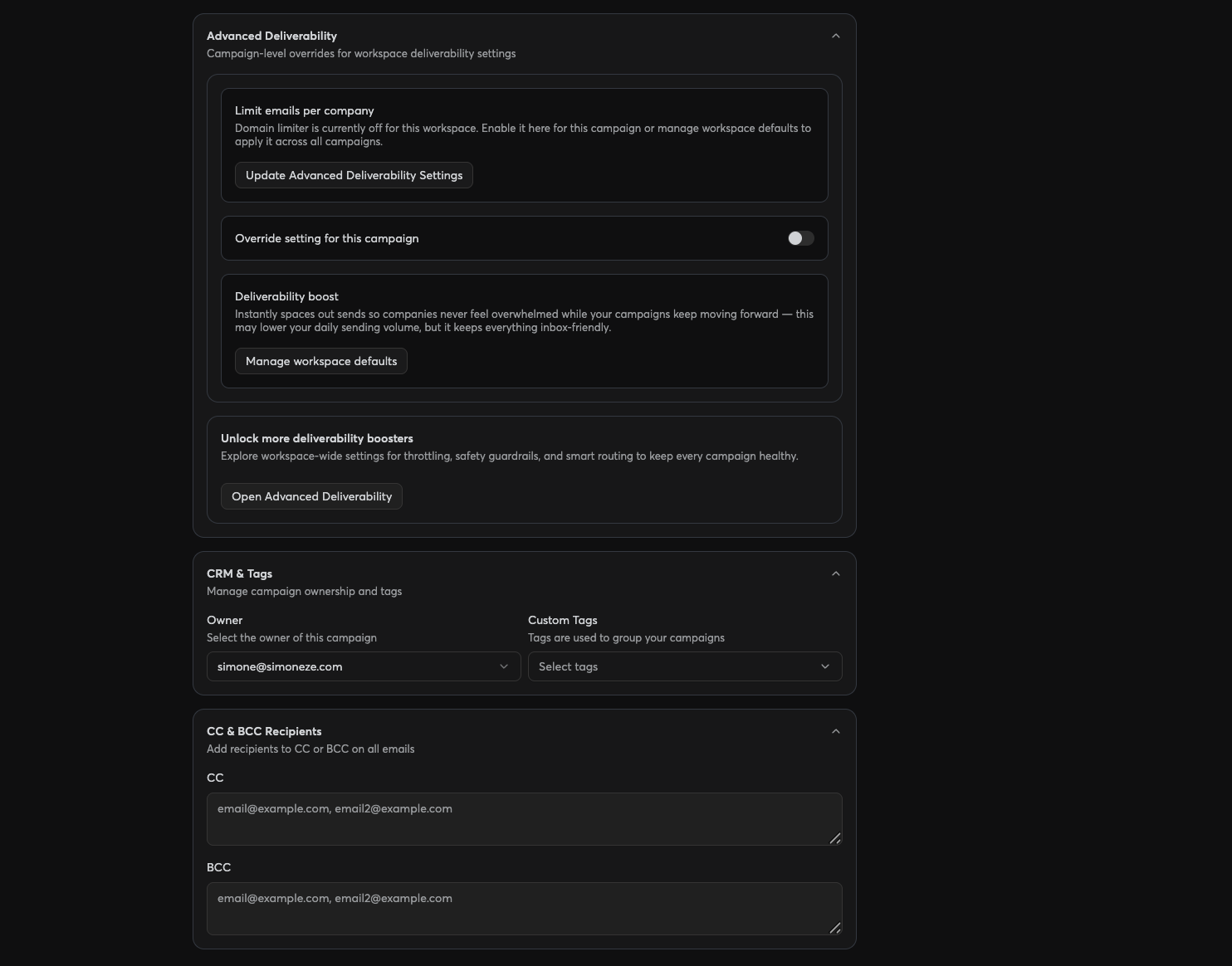
The timing controls that kept the rollout conservative.
Why turn tracking off?
Open pixels and tracked links create extra signals that can hurt a new sender. We did not need a pretty open-rate dashboard badly enough to trade away deliverability.
That is why the results in this case study focus on sends, placement, bounces, replies, questions, meetings, and revenue. I cannot show an open rate because we deliberately chose not to collect one.
Before launch, I sent test emails and checked the rendered message, SPF, DKIM, and spam score.
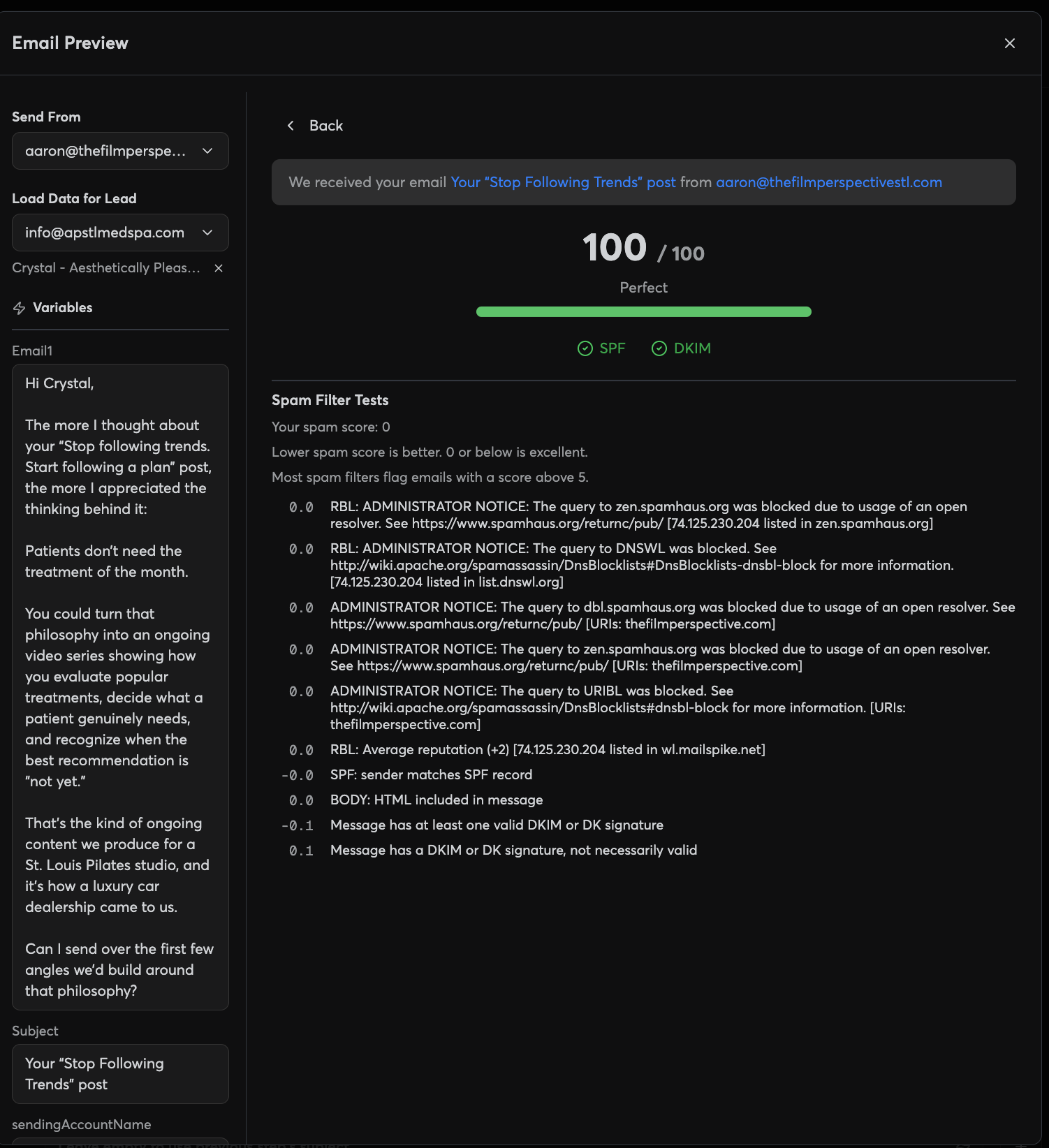
A sampled message scored 100/100 with SPF and DKIM passing. Useful, but still separate from inbox placement.
That distinction matters.
A 100/100 message test does not promise that every provider will place the email in the inbox. So I also ran a seed-inbox placement test across Google and Microsoft environments.
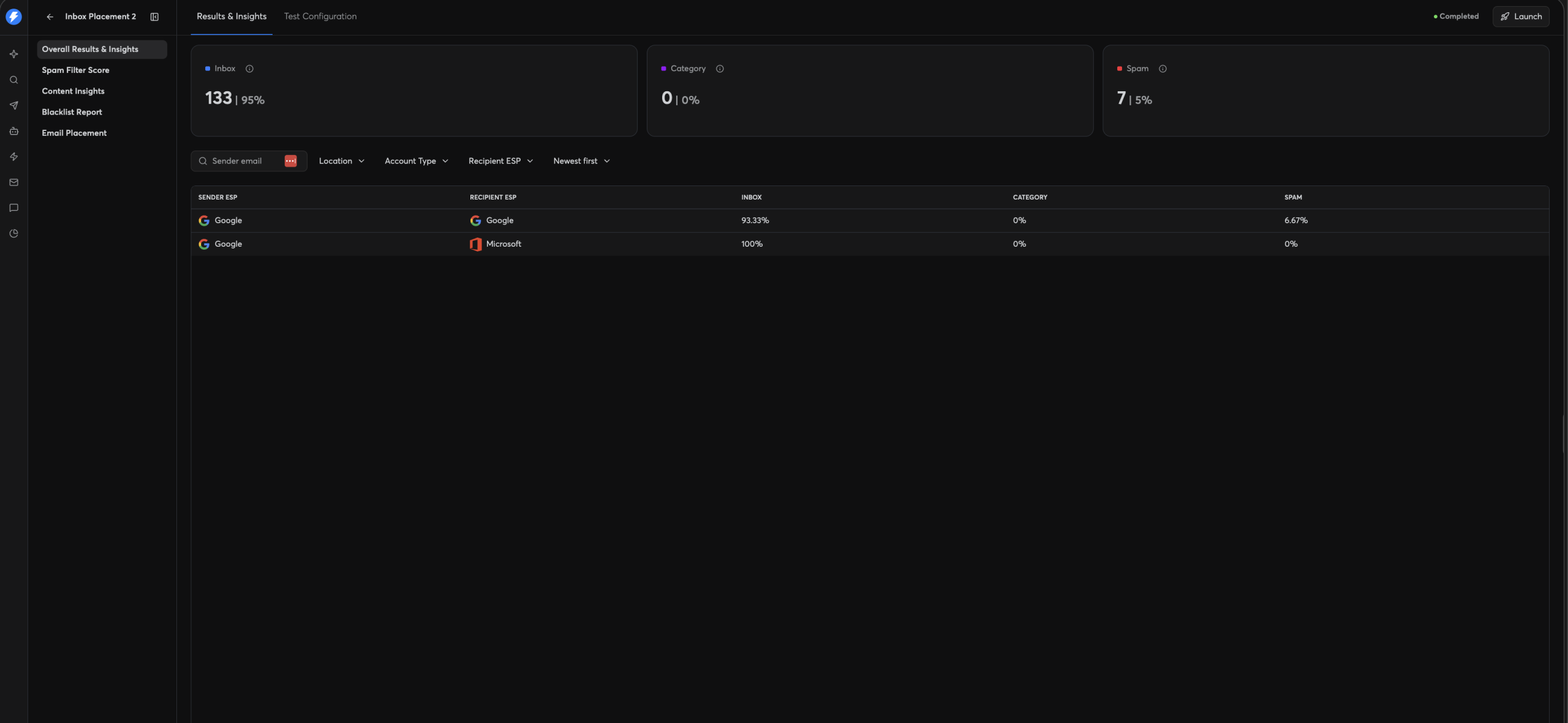
133 of 140 seed emails reached the inbox. Google landed at 93.33%; Microsoft landed at 100%.
The final placement result was 95% inbox and 5% spam. That cleared the launch bar.
We started small on purpose…
The first campaign was a seven-contact Microsoft pilot.
It completed all three touches: 21 total sends, zero recorded bounces, and no replies.
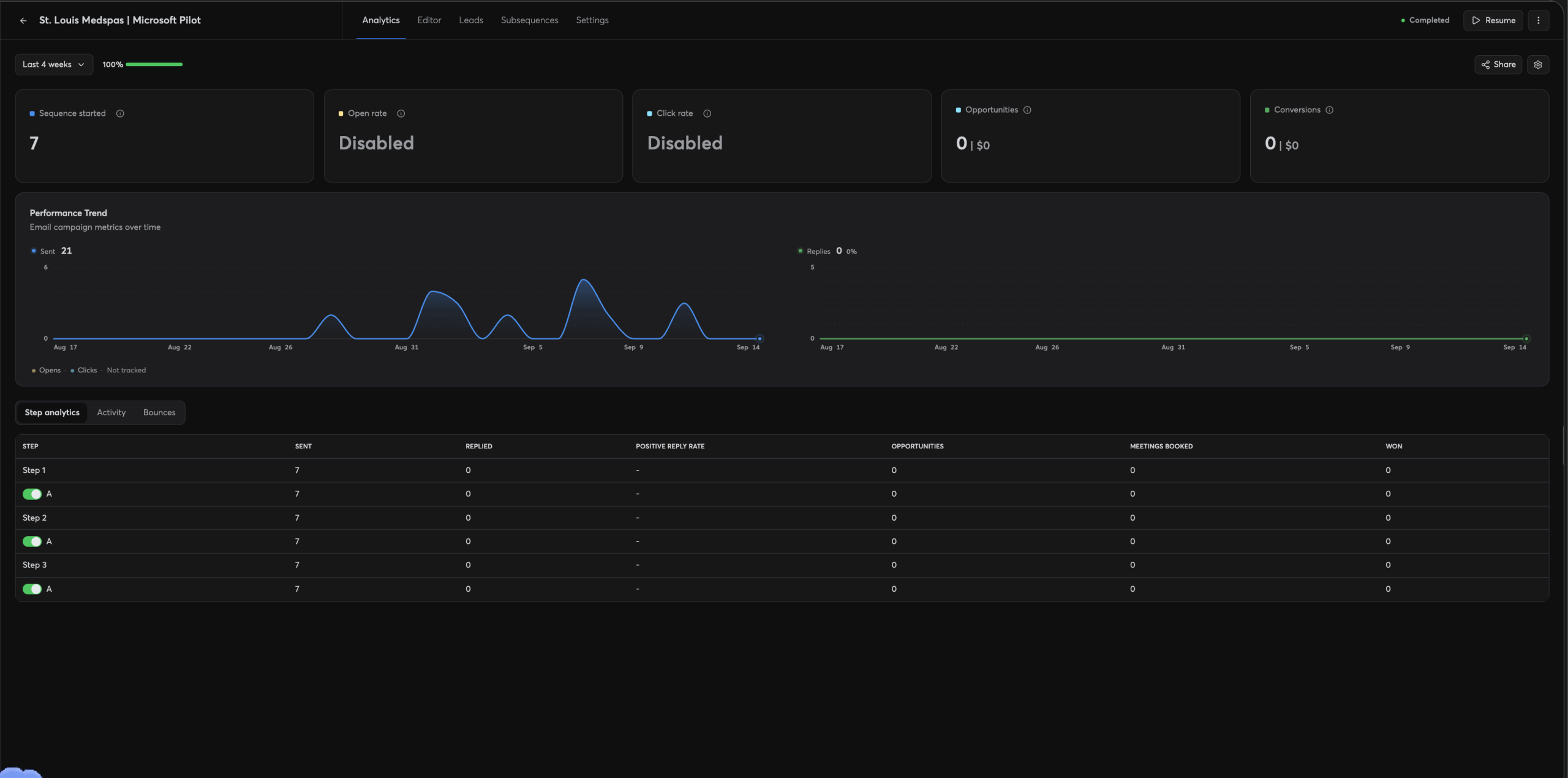
Seven contacts completed the three-step Microsoft pilot.
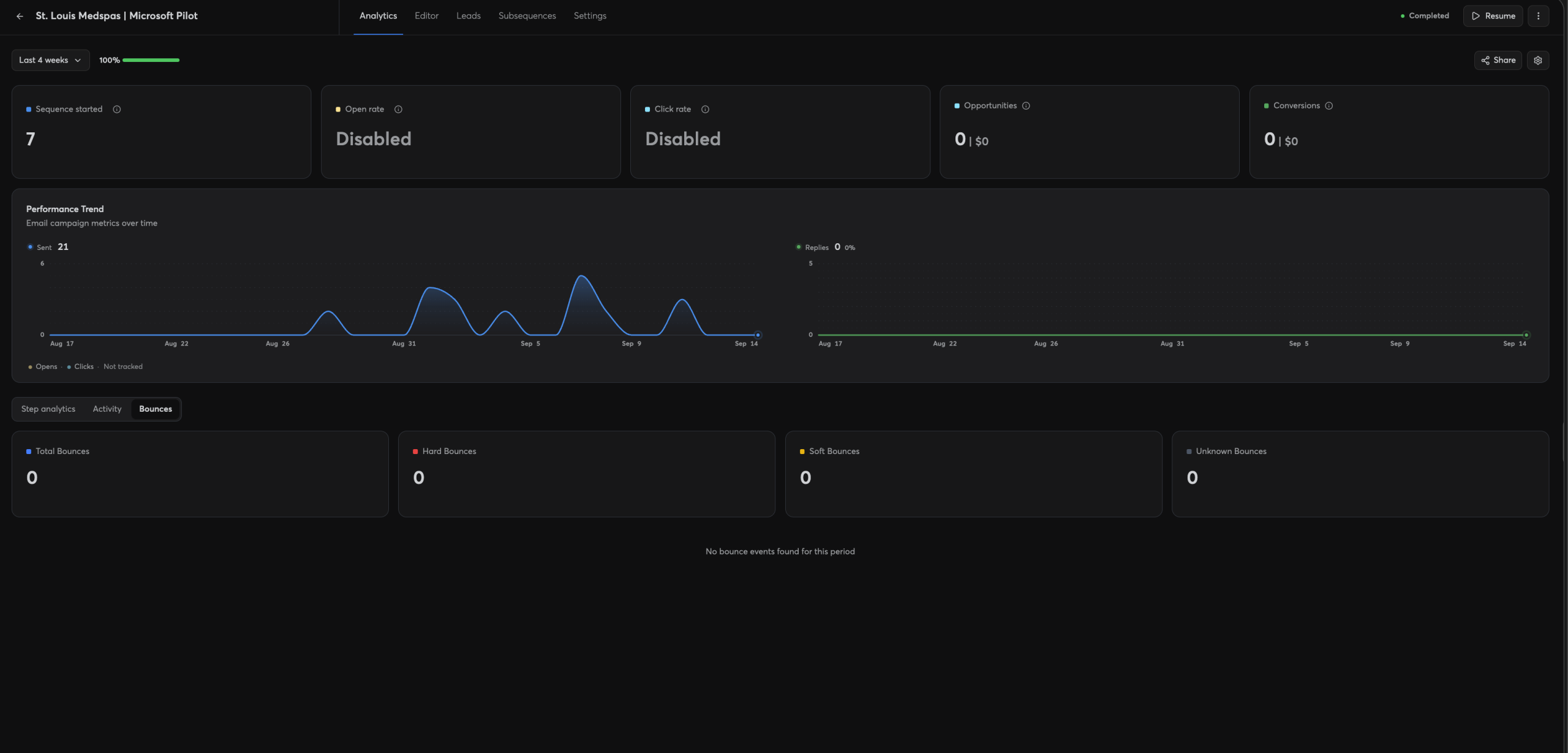
Zero hard, soft, or unknown bounces in the pilot.
There was one process mistake worth mentioning.
Two pilot emails went out before I sent Aaron the final settings screenshots for confirmation. The copy was approved and the settings were correct, but the screenshot was his last gate and I should have waited.
I told him what happened, sent the screenshots, and made the gate explicit going forward: approved copy plus confirmed settings equals launch.
I am leaving that in this case study because a clean story is less useful than an honest one.
Once the placement data held and the remaining copy was approved, the second campaign went live with 24 contacts across the remaining providers.
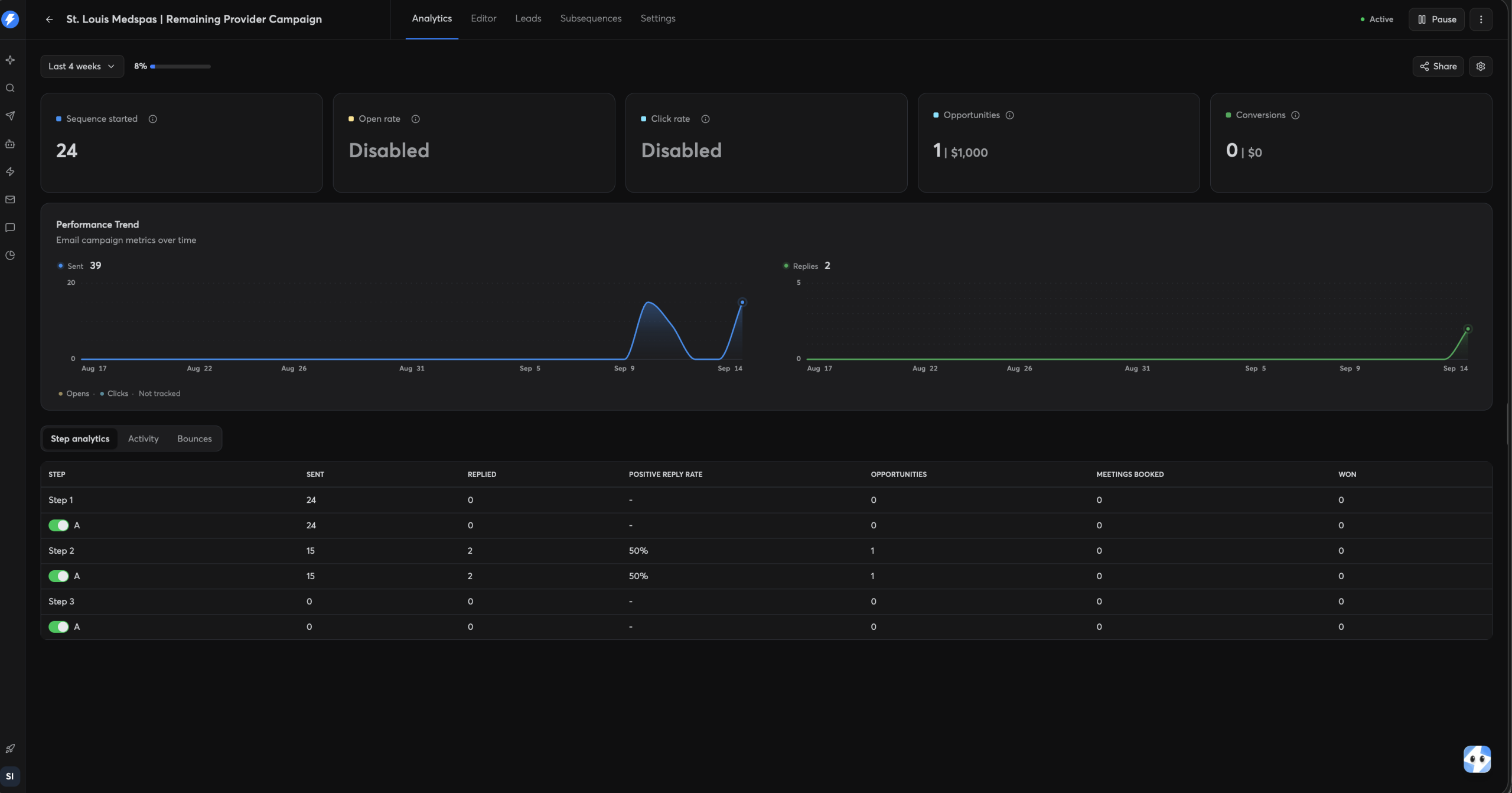
The broader campaign after the pilot: 24 contacts, controlled at 15 emails per day.
The first booked call!
The first owner reply did not say immediately say “I’m in book me…”
It said:
“What is this for? Our own personal use, something you market? Is there a cost?”

And that reply mattered because it showed the email had created enough interest for the owner to ask how the offer worked…
It also kinda exposed the part of the offer that needed a bit of tweaking.
The emails made the content ideas clear but did not make the ownership, distribution and monthly-service model clear enough for everyone…
Aaron answered personally and the first booked call was arranged!
Another recipient sent a polite opt-out after the second touch.

A clear opt-out. It belongs in the suppression process, not in a “positive replies” screenshot.
The campaign’s reply handoff was designed around that reality. Every business day, Aaron needed the positive and neutral replies with the company, contact, email, verbatim response, and my read. Opt-outs needed same-day removal. “Not now” replies stayed tagged for a later follow-up.
And because cold replies can contain unsafe links or attachments, I did not open anything inside them.
What the early numbers actually say…
As of September 16, 2026:
- The Microsoft pilot had completed 21 sends to 7 contacts.
- The second campaign had sent 48 emails across 24 contacts.
- Combined volume was 69 sends.
- Both campaigns showed 0 recorded bounces.
- The seed test showed 95% inbox placement.
- Two distinct people replied. Instantly displayed three reply events because one person replied twice.
- There were 0 booked meetings, 0 conversions, and no verified revenue from the campaign at that point.
The technical side was doing its job. The mailboxes were authenticated, the placement test cleared the target, and the verified list produced no recorded bounces.
The commercial side was still early.
One book call! 1 person declined… That is useful signal, and an intial but early proof that the offer is beginning to wins the market…
What I would test next…
I would not respond to these numbers by dumping another 1k+ contacts into the campaign.
What I’d do is tighten the offer explanation first.
Lauren’s initial question told us exactly where to work… which is make it easier to understand that the videos are produced for the client’s own marketing, explain how the ongoing service works, and answer the “is there a cost?” concern without turning the first email into a price sheet.
I would also keep the business-specific series idea intact which I believe is the best part of the campaign…
Because that is what gave the prospect something concrete to react to… Now the next iteration should clarify the service around the idea, not replace the idea with generic agency copy.
And I would keep volume controlled while the domains continue to build history. At the moment the clean placement at 69 sends is encouraging but it’s definitely not permission to get reckless.
The part most cold-email case studies skip…
The emails were only one layer of this job.
The campaign worked as a system because the pieces agreed with each other…
- The sending domains could authenticate the mail.
- The list matched the client’s actual buyer profile.
- The mailbox existed and was verified.
- The proof line was true.
- The idea came from something the business had already shown it cared about.
- The client approved the copy and the settings.
- The launch was small enough to learn from.
- The replies went back to a human who could continue the conversation.
That is the work I do when I build cold email.
I do not begin with “How many emails can we send?”
I begin with “What has to be true for the right person to receive this, trust it, and have a reason to answer?”
If you have a service that needs trust before someone books, I can help you build that kind of pilot—from the sending setup and research to the emails, launch controls, and reply handoff.
Bring me the offer, the proof you can honestly use, and the kind of customer you want more of.
I’ll help you turn it into a campaign worth sending.